Developer Notes
A Conversation About Small Saga
The following is an unabridged transcript of a conversation between Darya, Kevin, and Leo, uploaded here for reference and archive purposes. It's about 8600 words.
An abridged version (about 25% shorter) will soon be available in the Small Saga game, under the Extras option.
Jump to section...
1. INSPIRATIONS
2. DEVELOPMENT HISTORY
3. THE PORTING PROCESS
4. COLLABORATION
5. THE CAST
6. THE UNDERRIVER
7. MURIDA
8. SKY GARDEN
9. POLITICS
10. CUT CONTENT
11. NEW CONTENT
12. GETTING WEIRD
13. THE FUTURE
~~~
Darya Noghani is the creator of Small Saga. After studying Serious Games at Coventry University, they created Aviary Attorney. They then moved to London where they designed, wrote, programmed, sprited, and produced most of the music for the PC version of Small Saga. Their favourite rodent is the St Kilda field mouse.
Kevin Colegate is the programmer responsible for porting Small Saga to consoles and implementing new features. Born in the Philippines, he has lived in Saudi Arabia, England, and Portugal. As a co-founder of the company Vertical Reach, Kevin has both created and ported a range of games, including the console version of Aviary Attorney. His favourite rodent is the beaver.
On the 1st of July 2026, Darya and Kevin sat down to talk about Small Saga. They set out to reflect on how the game came to be, how the porting is going, and where things might go in the future.
1. INSPIRATIONS
A very early piece of concept art, drawn by Darya while trying to work out the overall look and feel of the game.
Kevin: Where did the idea for Small Saga come from?
Darya: I didn’t have any single spark for the idea. I think it was just a conglomeration of things I liked at the time. I like rats, I like mice, I was reading Berserk, I like classic RPGs like Final Fantasy 9 and Golden Sun, so all those ideas kind of mingled into something else.
Kevin: I think a lot of people’s first instinct when they see it is, “it’s Berserk, but with mice!”
Darya: The main one people list is Redwall. It’s interesting, I did read Redwall as a child, but it wasn’t the biggest inspiration. A bigger one for me was this book series called the Deptford Mice, which is kind of a gritty, real-world Redwall.
Kevin: Gotcha.
Darya: I read it as a kid. Then I forgot about it. But I remembered a scene of a rat whose lips had been cut off so he was constantly grinning. Then later on, as an adult, I thought, that wouldn’t be in a kid’s book. I’m making that up, distorting my childhood memory. But then I checked and no, no, that character is in there. It’s a gritty mouse story for children.
Kevin: Children’s media used to go places. Especially animal characters, I feel.
Darya: Especially British animal characters.
Kevin: That’s so true. Is Watership Down British?
Darya: Yes, it is. That’s also related to Small Saga, in that it has a sort of grand mythology of real-world animals. There’s another work from the same author called The Plague Dogs about dogs escaping from a testing lab. It’s like Watership Down but more depressing.
Kevin: That sounds hard.
Darya: It goes very hard. But it has the thing about escaping lab animals that I found compelling.
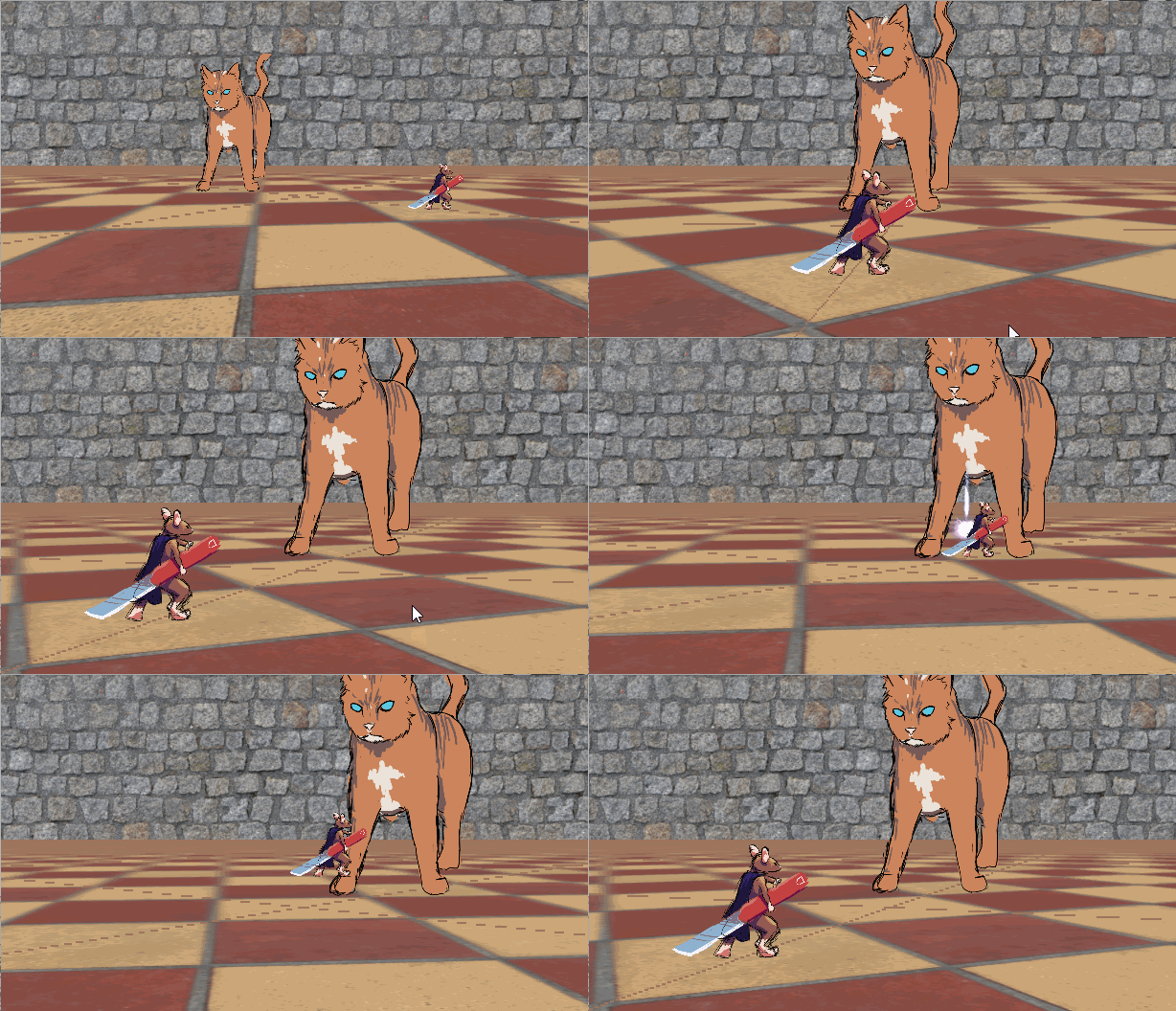
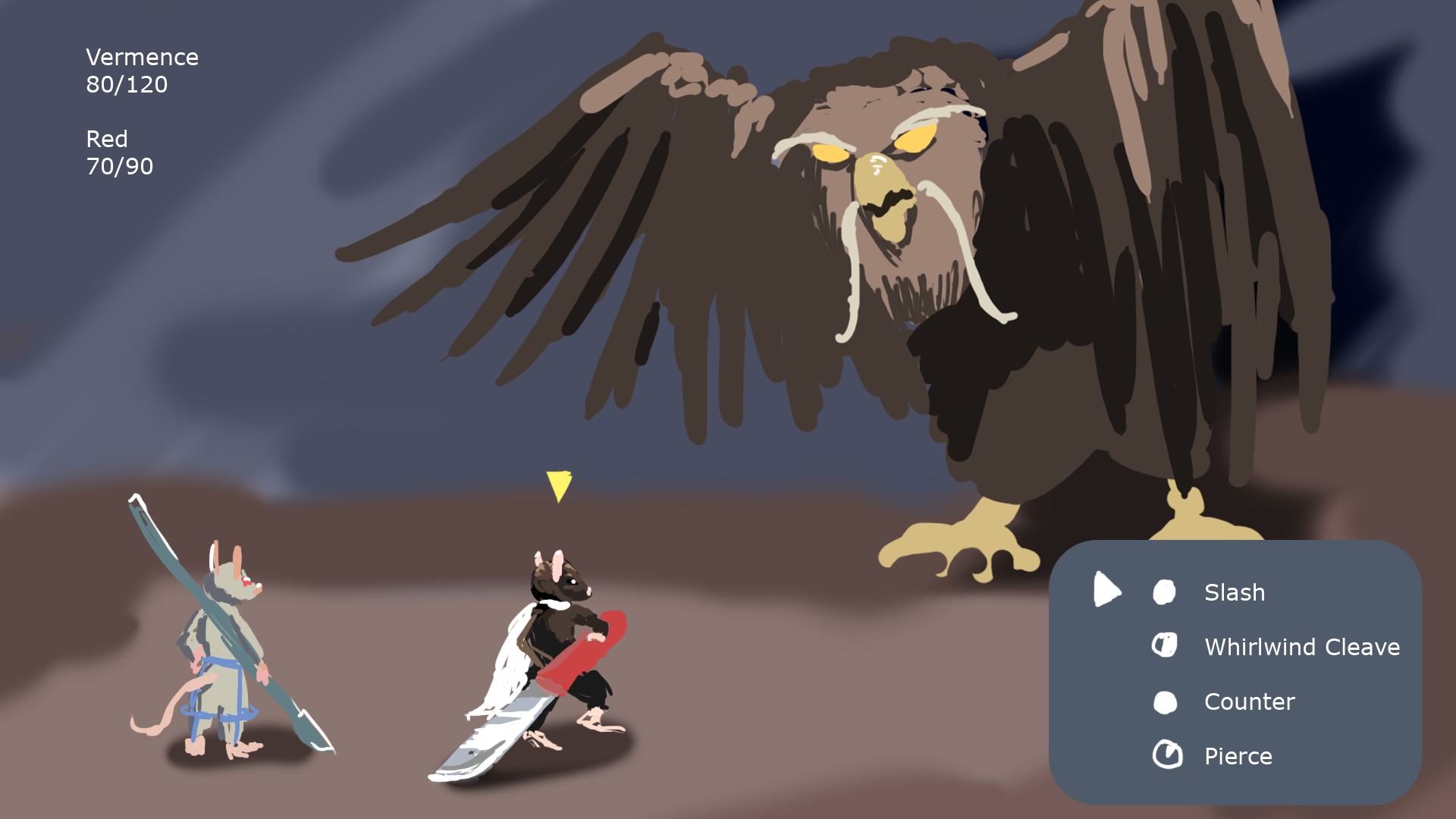
An early battle scene prototype with a “Mode 7” pseudo-3D camera.
Kevin: You had these inspirations. I’m looking at your dev notes. It seems to me the idea came out pretty quickly, quite fully formed, at least for how the game was going to be presented. Like, I’ve got your screenshot for your concept for battles, and the final result is extremely close.
Darya: Yes and no. I knew I wanted to do a game about a little mouse with a penknife. That was the core idea. It could play with scale. It could feature big monsters that were household pets. But I didn’t actually know what genre it would be, would Verm make friends along the way, what tone would it take, things like that. Like, for a while, I thought it could be an action platformer.
Kevin: Before you knew you wanted an RPG, I guess you were trying various things.
Darya: Yeah. But if you want a sense of scale, little guys facing something big, then an RPG is a good format. You kind of need a low angle camera to do that though. If you do it side-by-side, you don’t really get that sense of scale. SNES Final Fantasies, you don’t get a sense of scale, even if you’re fighting gods and things.
Kevin: It’ll be like, the boss has got the more detailed sprite, so I guess they’re bigger.
Darya: But then you got to the PS1 era, and they started playing with camera angles more. They would use a really low camera angle if you were fighting a big boss.
Kevin: You’ve shown me early Small Saga footage using the dynamic battle camera. Very quickly in the game you settled on using Mode 7.
Darya: I think Golden Sun was the inspiration for that. The context, for people who don’t know, it was a Gameboy Advance game that was very pretty, used a lot of prerendered 3D sprites, and then used fancy maths to manipulate them onto skewed and rotated levels to give the impression of very dynamic 3D.
Kevin: ...On the Gameboy Advance. So it really stood out, the battle scenes especially.
Darya: I don’t know if it was the best RPG on the GBA, but it was the one that people remember.
Kevin: I have to admit, I’ve never played Golden Sun or its sequels. I’m going to get around to them eventually. They are such a cultural touchstone.
Darya: Do you know who did the music for it?
Kevin: I do not.
Darya: It is Motoi Sakuraba, who does all the fancy prog rock for games like Valkyrie Profile and Star Ocean. He also worked on Dark Souls. He’s the one you go to if you want music that’s a bit ostentatious, a bit out-there.
Kevin: And this is where you say, “you got them”.
Darya: I do like some good prog rock. I was brought up on things like Castlevania 2, which I was not very good at as a five year old, but that rock-influence did leave an impression on my brain, and now if any game that has a banging soundtrack with drums and guitar, then I’m into it.
Kevin: There are definitely some tracks that are reminiscent of that.
2. DEVELOPMENT HISTORY
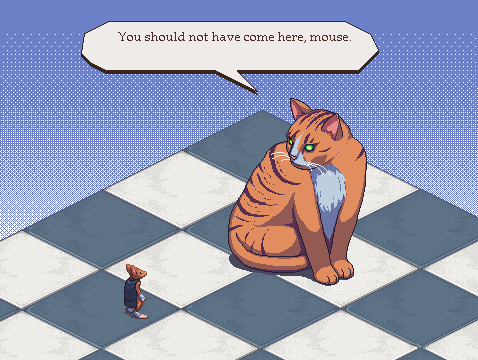
The very first scene implemented in the game.
Darya: So, this was around 2017. I had just made Aviary Attorney, and I worked with you and Leo on the port. I’d been making a few little prototypes, but I wanted to work on this big game, and I was afraid to work on it because I could tell that it would be a five year project from the start. Eventually I decided, I don’t want to work on these tiny games. I want to do the five year project and just... give it a go, see what happens.
Kevin: Oh jeez. You thought it was going to be five years from the go?
Darya: Yeah. I mean, it’s an indie RPG. There are ways doing it intelligently, but I wanted to do a big, sprawling RPG. There’s no way to cut corners here. It’s going to be a five year project minimum. And that’s pretty close to how it came out, so I got lucky with that estimation.
Kevin: Good job.
Darya: That never happens in games development. Anyway, I got to work. What did I do first... I developed the starting area of the game. It was the kitchen area with Tiger, then I went back and did the sewer section with Sava. I worked on that for about a year, then pitched it to a few publishers – and they were interested – but I was unsure about working with them, so I went with Kickstarter.
Kevin: Which you had experience with before.
Darya: Right. And that was a big success. So I had funding. Then a few years later I had a game. It came out.
Kevin: [Laughing] That’s the truncated version. You started, and then you finished it.
Darya: It was a smooth development. I worked with a couple of people towards the middle-end, where I just thought, I should bring in more composers, some guest artists for a couple of things. There was Kofi Young, who did the bard and credits music, and Evelyn Lark, who did the White God boss music.
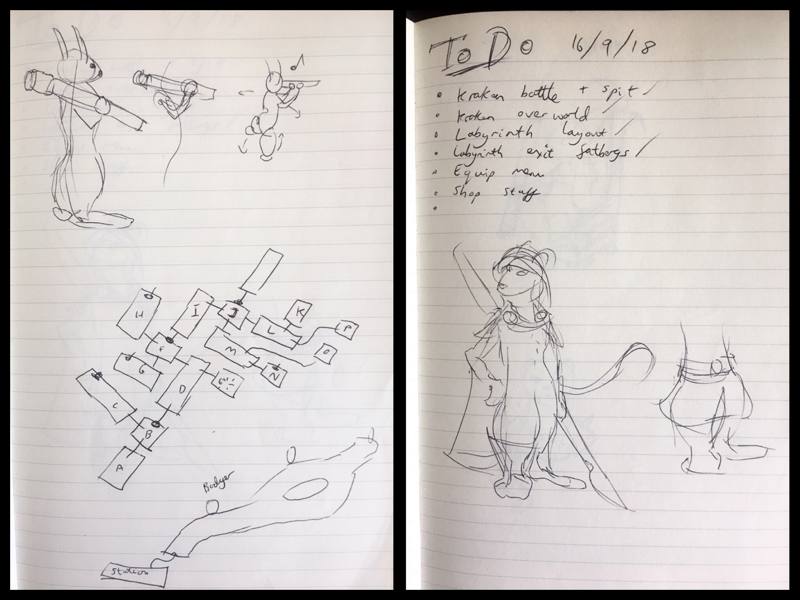
A to-do list and design sketches from early in development.
Kevin: Was there always the intention to work with people as you got further in, or were you like, “I’m going to do it all”, and then realised it was a bad idea and felt overwhelmed.
Darya: It actually came down to how much money I had. I was thinking, do I have enough money to take me to the end of the project? Yes. Do I have enough money to hire musicians? I’m not sure.
Kevin: I see. That makes sense.
Darya: Towards the end, I realised I did have enough money to hire someone to do these bard songs, which was handy because I can write guitar music but I can’t sing. That was a really good choice because Kofi did a great job.
Kevin: I love the bard songs. They really stand out in a game where there’s no spoken dialogue otherwise.
Darya: If every track is sung, then it’s something. But if one track or only a handful are sung, then they stand out. Anyway, I did crunch a little towards the end. In the last year, I put my nose to the grindstone to get it finished before I ran out of money, and before I burned through the good will of the Kickstarter backers.
Kevin: Right.
Darya: I could have carried on polishing it for another five, six years, but you can’t do that with a game. There’s a point where you have to draw a line and say, “this is polished enough.”
Kevin: Of course.
Darya: I was happy with it. I released it. It did fairly well. And then I wasn’t sure what to do. I wanted to take a break. I wanted to recover from burnout. I did prototype a couple of things. A few months later, I spoke to you. I was looking vaguely for someone to port Small Saga to consoles, and I had a couple of people in mind. You weren’t high on the list...
Kevin: That hurts.
Darya: ...Because I knew if you were to port Small Saga, you would have to remake it from the ground-up. I used Construct 2, which is an HTML engine. It’s very fast to work in – that’s why I chose it. I knew it inside-out, and it was the only way I could have made the game in six-and-a-half years. But I knew that you can’t just put that code onto consoles. You have to remake it in a more normal engine, a more sensible engine. I thought, “I can’t put that burden on Kevin. He will die”.
Kevin: Porting it has been... it’s been an experience.
3. THE PORTING PROCESS
Darya: Well let’s talk about that. What were the porting challenges?
Kevin: I guess the first challenge is I completely misunderstood the scale of the game. I mean, I played it. I’m just going to come out and say it: I was the first backer on Kickstarter.
Darya: That’s true. That’s literally true.
Kevin: Then I played it at launch, all the way through in one go. It was great. Really enjoyed it.
Darya: And then you thought, “I could port this in three months”.
Kevin: Well, no. I thought, “I would NOT want to port that. Big game.” But clearly I forgot while Leo and I were doing our own projects. I thought, in that time, that you would find someone else to do the port. I think it was... how long was it afterwards? About a year later?
Darya: About a year.
Kevin: I asked if you had found anyone. I thought it would be nice to do a small project where I don’t have to think about the design decisions, and here’s a small game that I know is good. I asked you to send me the files so I could have a look at it and determine how long it would take. You made the game in Construct 2. It’s a visual scripting language, but only sort of. The way it’s formatted is much closer to traditional code than what I work entirely in, which is Playmaker in Unity, a node-based Finite State Machine system. So the order of operations works exactly as it’s typed out in Construct, but in FSNs the order of operations is more obscure. And there’s all kinds of differences in how the two engines render, how they build a scene. It’s two quite different systems, and Small Saga has moved from one to the other. It’s what I did with Aviary Attorney, and it worked there.
Darya: I knew you would do a good job. The Aviary Attorney port, to my mind, is far and away better than the PC version.
Kevin: Well thank you very much. That’s just the benefit of additional development.
Darya: So I sent you the files.
Kevin: I came back a week later with a little game where you could run around as Verm, and it had the sewer scene, the water, the talking. I thought, “no problem. I can port this in three months, not a day longer.”
Darya: I politely rebuked you there. I said something like, “I’m not sure if that’s true”, which is the polite way of saying, “no you can’t, you absolute fool”.
Kevin: [Desperate laughing] The politeness eventually goes away. I’m very thankful, doing this whole process, you’ve never held my feet to the fire whenever I set a date. Which is good, but eventually I stopped setting dates.
Darya: I knew what I had given you. I knew what I’d cursed you with.
Kevin: Imagine if I did it in three months. You would have been very impressed.
Darya: I would have been scared, to be honest. I don’t trust developers who make things in three months. Like, a Short Hike and the Binding of Isaac. That’s terrifying. I don’t know what they’re doing.
Kevin: They never slept. So this went from three to six months. We got the battle system sorted. Coordinates are completely the opposite in Unity from Construct. Y going positive in Construct goes negative in Unity. That alone, when getting the scenes in with XML data, made everything come in inverted. And all the movement code had to change, which isn’t terribly complicated but can lead to small issues throughout the game. The scale is different too, what Construct considers one unit compared to what Unity considers one unit. In terms of timeline, it went from three months, to six months, to nine, and then no more timelines. I thought, “oh man, we’re in it now”. We’re coming up on, or maybe we’ve passed, two years at this point.
Darya: It hasn’t been two years. It’s been, like a year and a half, maybe.
Kevin: It’s two years. We’re approaching it.
Darya: Hold on, I’m checking my emails. Let me find out when I sent you the files.
Kevin: There were a couple of points where I thought I might have to cut and run.
Darya: [Checking emails] Oh god, it was June 2024. It’s been over two years. I’m sorry for inflicting this on you.
Kevin: It’s classic game stuff. A lot of it really took shape pretty fast, and then it’s a lot of the nitty-gritty. The ported game was not functional to play through for over a year. There was so much stuff to work out, and every time I’d advance there would be some brand new instance of “Darya did this”, which would only be used for a few scenes. Like the scenes with god-rays, remaking plug-ins, shadows, the whole Mode 7...
Darya: Music as well. I made music files rewind, rather than just loop to get around a Construct bug, but of course that makes it much harder for Unity which doesn’t have the bug.
Kevin: Yeah, that was a whole different thing. But other than taking many times longer, all of this was the route I expected it to take.
Darya: I warned you from the start!
Kevin: There’s no blame. It’s been fun, and it’s been not fun, but it’s almost never not been interesting.
4. COLLABORATION
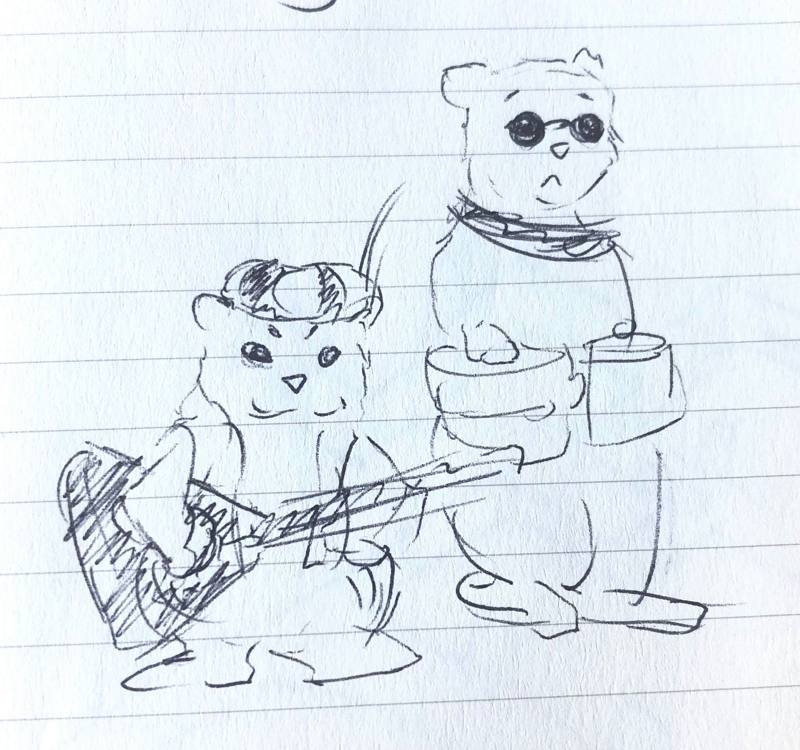
Concept art of Anton next to a lemming wearing dark glasses and holding bongos.
Darya: There’s something strange from moving from a “solo developer” to working with people. You have to... not concede, not give up on stuff, but understand what comes with a group project. It was the same with the music, where I was like, I know exactly how I want the guest music to sound, but I’m not going to override whatever Kofi and Evelyn offer, because they’re going to show something interesting, do something I won’t expect. It’s not the auteur way to do things. The Hideo Kojima way would be for me to oversee it, and say, “I want it to be done exactly like this, why are you deviating?”
Kevin: Right. That full authorial control. But it would be hard to work that way, wouldn’t it? Someone else can bring something new – not necessarily better, but different.
Darya: This touches on something interesting, which is the Kickstarter backer characters. So, when I launched the Kickstarter, I needed some higher pledge tiers for more money, so I added options for people to add paintings to the game, little NPCs, boss battles. But then I thought, “oh no, I’ve done too many, now I have to add these twenty characters”. That was a challenge because I knew most of the backers would understand what the game is about, what the tone is, but I knew some of them wouldn’t and would want something completely out-there. Fortunately, all of the suggestions were okay. They were all things I could with. And when I spoke to people and said, “I’m not sure this element would work”, they understood completely. My goal was to integrate them so well that people wouldn’t be able to tell what’s a backer NPC and what isn’t.
Kevin: I was about to say, when you say “twenty characters”, are there actually twenty backer NPCs?
Darya: I think it’s about twenty NPCs. And three boss battles – the turtles, Pocket Jabari, and Rosaline and Maisie. Those are all NPCs from Kickstarter backers.
Kevin: That’s actually blowing my mind.
Darya: I think the scissor sisters are good examples, in that I tried to integrate them in the game, but I also took inspiration from them. When I saw the designs for how the backer wanted the sisters, I realised I could incorporate elements of their uniform into the thimble guard, and then everything would feel very seamless. They wouldn’t be out of place.
Kevin: You nailed it. I would never have guessed the scissor sisters. But did you know the whole plot? Did you know everything, or did a lot of it come as you went along?
Darya: A lot of it, in broad strokes, came together quite quickly. I knew you’d be travelling to Murida which would either be underground, maybe a London Underground station. I knew there would be a confrontation with a rat king. I knew Bruce would be travelling to Sky Garden and confronting his identity. I knew the shape of the story.
Kevin: Okay. You had the crib note edition of it. But where I’m coming from is, did you know there was going to be a thief character, or did you get the Pocket Jabari request first?
Darya: I think the original thing was Bruce going to Sky Garden with his dwarf hamster boyfriend, and also a third character, which was going to be a depressed lemming.
Kevin: [Long pause] A depressed lemming.
Darya: From Norway.
Kevin: Okay.
Darya: They’re in the band together. I think the lemming was going to fill the role of Jabari, even though he had a very different personality. But as I was working, I realised the lemming wasn’t doing enough, and Jabari would be more interesting, he would add some conflict, so that was a good change. But a depressed lemming is a good character, I think. There’s something to that.
Kevin: But the jumping off cliffs thing isn’t real. They never did that, right?
Darya: Wow, I wonder what this says about depression.
5. THE CAST
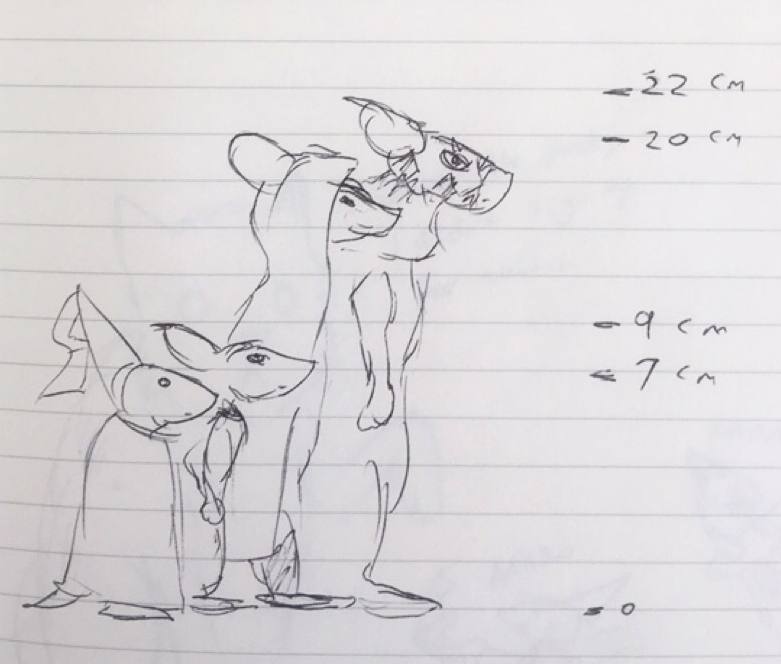
Early concept art of the characters. Darya noted their heights to help maintain consistency.
Darya: The four main cast... Verm, you can tell, has a very easy to write personality. I knew what he was doing quite early. Siobhan I also think was easy to write. They were going to be the bookish character, kind of supportive, but kind of young and trying to learn things. Bruce wasn’t the next I visually designed, but I knew I needed a joke character, someone to inject some positivity, and elevate the cast a bit. But I didn’t know what to do with Gwen, because at first she was quite similar to Verm. I can’t have these two characters who are both angsty edgelords. So she was the hardest to write. In the end I gave her a bit more of a punk attitude.
Kevin: That comes across. She’s edgy, but she’s not an edgelord.
Darya: Yes. Gwen is the most mature character, in that she has almost all her issues worked out.
Kevin: I feel like she has some hang-ups, and they come up in the game. Like, you return to White Hall and confront George et cetera. But she’s the one that’s got her shit together.
Darya: She’s almost the adult of the group.
Kevin: I would say that Bruce strikes me as, in human years, the oldest character. Gwen’s more put-together, but is the second oldest.
Darya: Gwen is the teenager who had to grow up fast. Bruce is the adult who needs to go to therapy for a little bit.
Kevin: What about Leo? Was he in the game from the start?
Darya: Yes. It’s a normal thing in storytelling that, if you have a protagonist, you have someone to counter the protagonist’s values. It has to be another mouse, a mirror image.
Kevin: Sure, sure.
Darya: It’s a very Guts-Griffith thing, or Sol Badguy-Ky Kiske, or... hmm...
Kevin: Keep listing them.
Darya: Actually, I think those would be the two main ones, at least aesthetically.
Kevin: With Siobhan, one thing I think is funny is that they’re most damaging character. In terms of big numbers, just pop the hoo helm on them, give them some charges, use spreadfire, and it kills everyone. To me, that’s a very funny thing for the character of Siobhan.
Darya: There’s something humble about them. Here’s this tiny mole, a noble person... nobody thinks Siobhan is a threat.
Kevin: But they’re the biggest threat of them all. Verm can wipe out something big, but Siobhan is who you call if you want to take out a hundred soldiers.
6. THE UNDERRIVER
Darya: The strange thing about the game is that I worked on it linearly, so the early development stuff is at the beginning of the game, and the things I worked on last are at the end. So Cranbaile I’m not really happy with because it’s something I made eight or nine years ago now. If I were to do it now, it would look a bit different. The prologue section with the sewer feels very basic. It’s a strange path – the little maze sections feel awkward – so I would definitely do that differently. But on the other hand, it’s kind of cute how the game grows out of this.
Kevin: The prologue sewer almost feels like a development test. The pipe maze feels like a test of swapping objects on and off.
Darya: That’s pretty much what it was. The sewer was me seeing how big I can make a level without breaking the game engine. I made the level bigger than I thought I’d need.
Kevin: It’s huge! It’s one of the biggest maps in the game! The backgrounds of the game are generally one big sprite image. The only place that’s not true is the palace, where you split the background images into smaller sections.
Darya: By that point I was more conscientious about file size and efficiency.
Kevin: That was a good thought. The sewer scene is... even in the final build on Unity, it’s one of the few that can’t be compressed because it’s so much bigger than everything else.
7. MURIDA
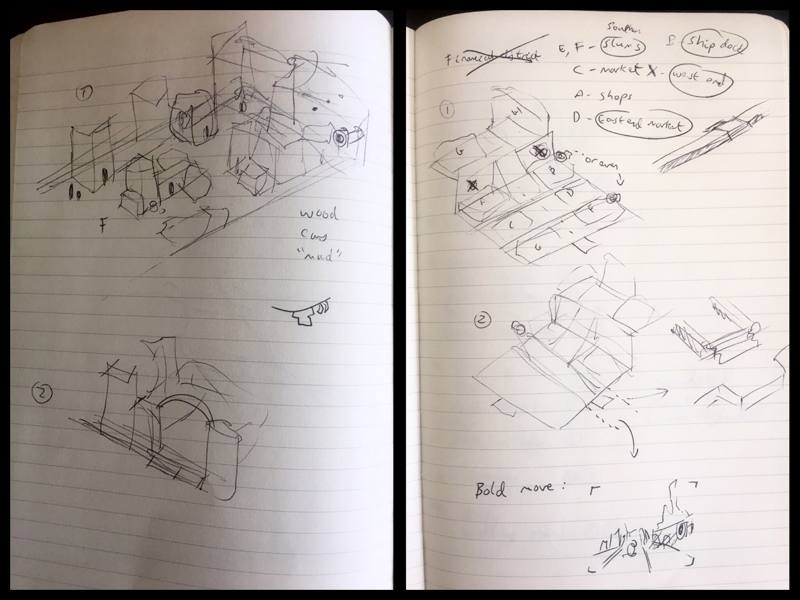
Concept art of Murida, investigating possible city layouts around a train track.
Kevin: I remember talking to you while you were developing the game and asking, “how big is it?”, and you threw out a number, “four hours, maybe longer, but it’s called Small Saga, so that’s okay”. But the game expands pretty fast. When you hit Murida, it feels really large. There’s a sense that it’s a city.
Darya: That’s an RPG staple. You arrive in a big city, and you feel overwhelmed. There are too many places to see.
Kevin: Is Murida the same as how you imagined from the start?
Darya: It’s pretty much the same. Murida’s the place I thought about the most because I knew it would be the most important city. It was originally set in a train station, all playing around the tracks, a very long city, but not very wide. But as the game went on, I was putting in more and more train stuff, until it became too much, there were too many trains, so I stripped it out, piece by piece, until by the end, there was only one train carriage in an optional area. I don’t know if that was a mistake, but it was a strange thing.
Kevin: Originally it was all going to be set around actual tube lines, right?
Darya: Yeah, that was the fast travel system.
Kevin: So all the cities would have been connected by tube rather than pigeon?
Darya: Yeah. The problem was, if you have that, then you have to leave the tube station to get to where you want to go. So for Sky Garden, you have to get from the tube station to the middle of a park. For a human, that’s five minutes, but for a mouse...
Kevin: They can only cover these distances because they’ve got the pigeon. That’s in the Travel Guide. I’ve read it. Obviously I’ve got Murida’s layout burned into my mind now, but when you decided “okay, no trains”, was there just a station at the places Dizi currently is, or did you have to restructure the whole thing?
Darya: Something in-between? You can see the remnants of it in that you land on the roof of Parliament, and then you go down a long drainpipe to underneath it, which doesn’t really make much sense. It’s how I was trying to resolve all this, the missing trainline. If you imagine leaving and arriving on an underground train, that might feel more intuitive.
Kevin: I see, I see. I do wonder, there is a line from the loremaster of Sky Garden asking why the taxi rank is so far away.
Darya: He requests a shuttle-bug service.
Kevin: Right. And playing through for testing, many times I found myself asking, why is the pigeon so far from the city? Where is the closest save point? When testing the pivotal mid-game Leo battle, the closest save is wherever I took off from. Was that a purposeful decision?
Darya: It’s a little bit purposeful. The save format in this game is purposeful in that you have to go to a physical location, which has advantages for building tension. You’re suddenly in a battle with Leo and you think, “I haven’t prepared”. It makes you worry.
Kevin: For sure. Doing that boss battle, there is no save before it, except for Sky Garden. But the game gives you saves at regular intervals, normally before fights.
Darya: I tried to make sure you’re never more then ten minutes, preferably five minutes from a save point.
Kevin: I am a big fan of save points in RPGs. And from a dev point of view, it makes things much easier. I also like that every save point is a statue.
Darya: I like it when save points tie in thematically. You can use a bit of lore then. You can show a bit of ancestral worship with the rodents. But nobody in the game really talks about ancestral worship, it’s just something you see when the rodents make little figures of the people they admire. It’s kind of Roman in a way, so it might be the shrew influence.
Kevin: Like, nobody knows why they do it any more. It’s just a tradition. Thank the statue that you’re still alive.
Darya: I think RPGs succeed on how much they surprise you, be it aesthetically or narratively. You want to see all these little novelties and details. You want the world to feel big and lived in.
Kevin: All these areas, they do feel very different. Like, when you go to White Hall, I love the scene when you go through the toilet. It’s very funny.
Darya: The colour palette plays into that. You arrive in White Hall, and there’s a sickly white-green over everything. It doesn’t feel very nice to hang around.
Kevin: And every area feels unique like that. Every area has key colours to it. Was this your own original palette, or did you come up with the colours as you went, picking what felt right?
Darya: There were some deliberate choices. Like, there’s not much pure black in the game, it’s more of a grayish navy, and it makes the game look a bit washed-out, adding a not-quite-fairytail look. There’s something nostalgic to how it looks.
Kevin: I agree. When you see something a little washed-out, you think of watercolours. You never see rich blacks in something like that.
8. SKY GARDEN
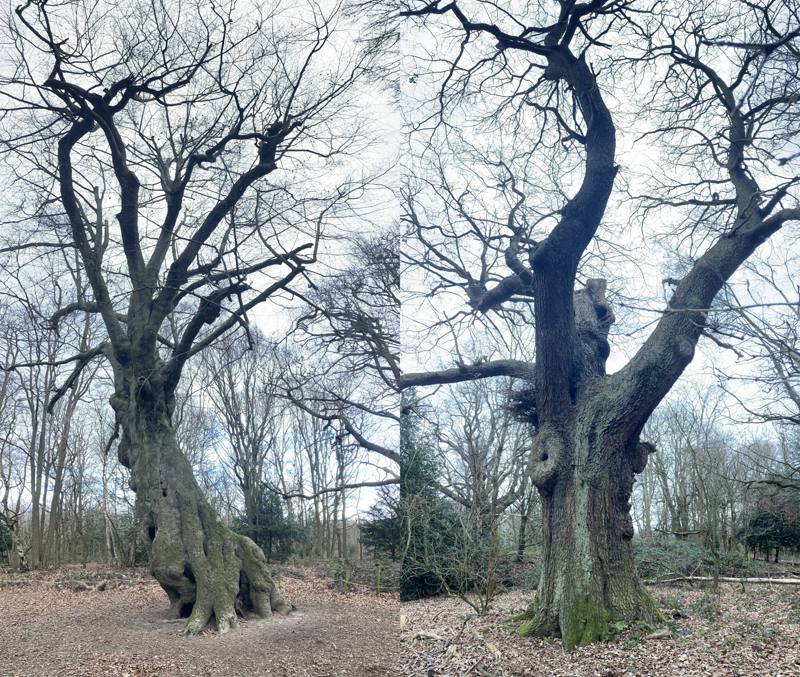
Two impressive trees from Hampstead Heath in London which were a partial inspiration for the trees of Sky Garden.
Darya: For me, the area that took a surprising amount of time to develop – and I think you’ll agree – is Sky Garden.
Kevin: Oh my gosh. I am trapped in hell and it’s called Sky Garden. From a porting point of view, the thing with Sky Garden is that it’s not that big. Sky Garden is five or six floors, all stacked on top of one another, all close to identical background-wise. But it is probably the densest area in the game script-wise. The amount that can change per room all the time is really dense. The most bugs, across the whole development is in Sky Garden, and it’s the most irritating to fix. But it’s the capstone to the first half of the game, isn’t it, so it’s super important. It’s great. I really like Sky Garden. I just didn’t like devving it.
Darya: I wanted to have this almost farcical narrative of running up and down, returning to it, having an elaborate jailbreak sequence. Have you ever played an RPG where the jailbreak sequence is disappointing?
Kevin: Sure. Probably. I feel like a jailbreak sequence in an RPG is another staple, isn’t it?
Darya: It is. It can’t be too short and easy. It needs some meat to it.
Kevin: I see. But you don’t necessarily want it to be too long. I’ve definitely played games where it’s jailbreak time, and you spend an hour trying to work through a dungeon. I’m like, “what is this? When will this end?” After the jailbreak you have that scene where you just take over the place, the cutscene called “dynamic entry” in the script files. It really stands out. There’s not really anything else like it in the rest of the game.
Darya: Okay. When I was a kid, I played Kirby Super Star (Kirby’s Funpack in the UK) on the SNES, and there’s a section on it called Revenge of Meta Knight.
Kevin: Oh yeah.
Darya: Have you played it?
Kevin: I’ve definitely played Kirby Super Star. It’s like a minigame collection, right?
Darya: Yeah. Short platformers. Revenge of Meta Knight, I didn’t realise as a kid but I do looking back, is kind of a take on anime tropes. It’s a dramatic, action-packed anime story, told through Kirby.
Kevin: Kirby’s always like that.
Darya: But as a kid who had no exposure to anime, I thought, “this is the coolest thing I’ve ever seen,” and it left an impact on me. So if you watch the first minute of the game, the opening cutscene, you’ll see it’s the same as the sequence with the owls. The music for that scene, the iconic halberd theme, is what I was trying to riff off for the dynamic entry scene. That piece has an absolutely jamming bassline.
Kevin: That Sakurai... I don’t even know if Sakurai worked on Super Star.
Darya: He did.
Kevin: You can tell. Whenever Sakurai does a Kirby game, or even any game, I’m like, “this guy gets it”.
9. POLITICS
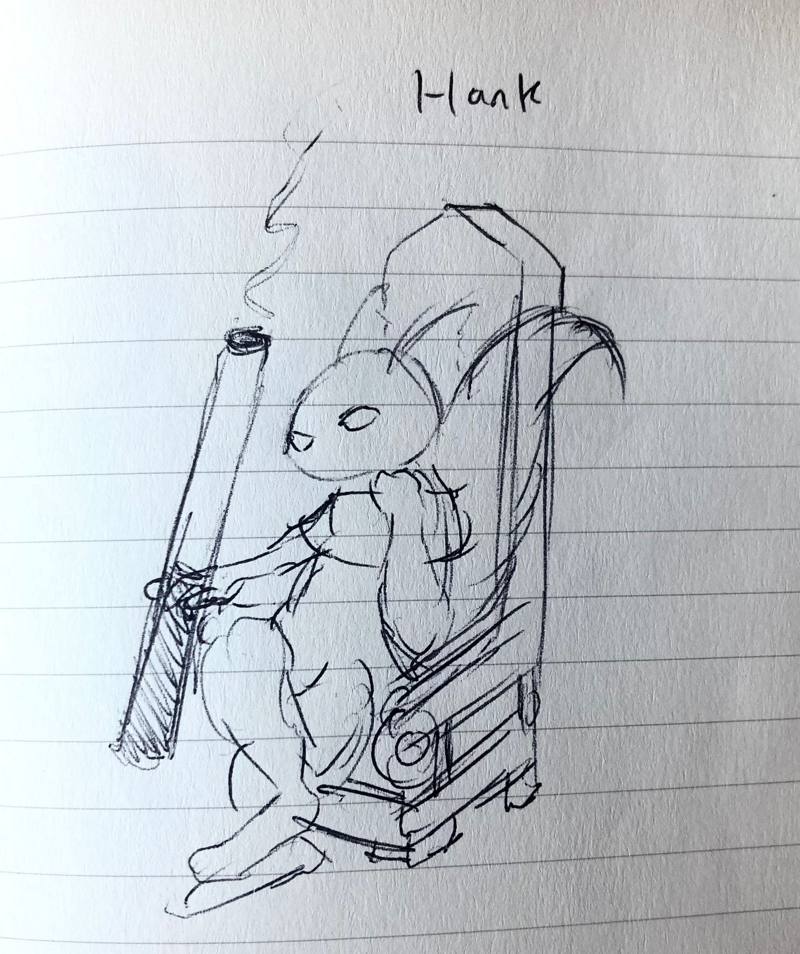
Early concept art of Duke Josh, here called “Hank”. Names frequently change over the writing process.
Kevin: The real world is changing, and the fascism that you’ve written in Sky Garden is extremely over the top. It’s not subtle. Since launch, and also since the start of development, it turns out that real fascism has also moved in that direction.
Darya: Are you saying it’s causal? Are you saying I did this?
Kevin: There are some comments on the Steam forum where people are like, “hmm, I don’t know if they’re really fascist.”
Darya: I don’t know if I could have been more explicit.
Kevin: They’re wearing Nazi uniforms! But was there a point when you were looking at this and realised it was becoming less and less satirical?
Darya: The game has been in development for a long time. When I was making Duke Josh, I wasn’t thinking of any particular political figure, and that’s true for the other characters of the game. But they do embody particular ideals or say certain real-world things. Part of my worry was that people would see Josh and say, “oh, that’s meant to be Donald Trump”, and that’s not really all it is. So I was thinking about where the world might go, and how that would change how people read the game. I think the more complicated one is the politics of Murida where it’s a monarchy, and I was trying to draw parallels with British politics, but it’s not quite as overt. If you’re unfamiliar with British politics, you wouldn’t know what quite to look for. And again, it’s not tied to particular political figures. You can’t look at the King and say, “oh, that’s meant to be David Cameron” or whatever. It doesn’t work that way.
Kevin: I feel like we don’t really see the politicians of Murida. The only figurehead we see is the King.
Darya: I allude to other masters, but yeah, you only see the people in the courtroom and the palace. Although, in Diego and Leo’s conversations, you get glimpses of politics, of how people view their roles through that.
Kevin: It’s pretty classic. Leo sees the error in his ideology, his belief-
Darya: I don’t know if he does see the error.
Kevin: But he notices the King is bad.
Darya: He thinks, this is a good system, the system is fine. So why isn’t this working? Why is the King doing bad things?
Kevin: And then he fights Verm. Someone who sees the error in their ways may have thought, there’s no need to fight. That’s something nice about Leo. You added a separate ending to that fight where you can choose to not kill Leo. I think it’s not that hard to spare Leo, once you know what to do, but since it’s the only fight where that happens, most people try to kill Leo straight away. Did you feel like you pulled that off?
Darya: When I made it, I thought I’d nailed it. I thought, this fight is really good, people are going to love it. But then it came out, and I looked online, and players weren’t finding it. Only something like three percent of players even knew you could do it. So in that sense I failed, I didn’t set up enough clues.
Kevin: Is that a failure? Maybe if people didn’t find it and you wanted it to be fifty-fifty.
Darya: I don’t know what I expected the percentage to be. But I think I did succeed, in that I wanted it to be a fight where you can kill him easily, or you can take the harder route of sparing him, and that’s how it came out. Some people said, “why’s it so easy?”, and I thought, “I was trying to do something thematic here”.
Kevin: It’s the easy choice to kill, it’s hard to be like, “no, you stick around”. I prefer the route where he doesn’t die. He’s not redeemed.
Darya: We were just talking about the politics of Leo, so what does it mean to not kill his politics? I leave that up to the player, which was a bit lazy on my part.
Kevin: That’s the Writer’s Trick.
Darya: But this isn’t Undertale. It’s not a lesson in pacifism. Maybe letting him die makes more thematic sense.
10. CUT CONTENT
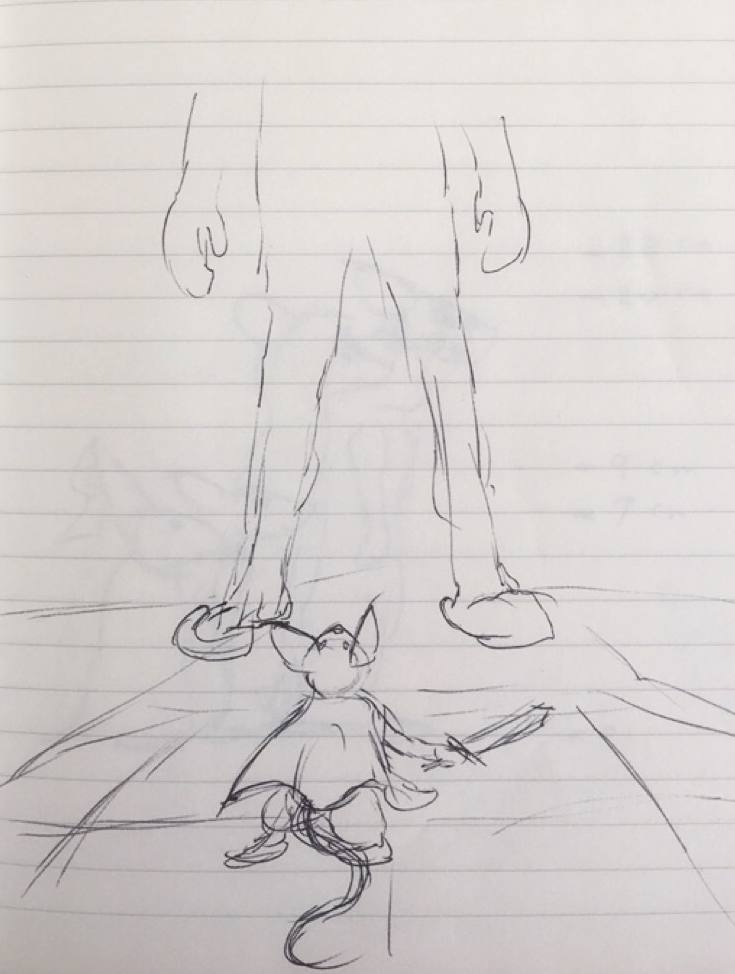
Concept art of a young Verm, still with his tail, looking up at the Yellow God.
Kevin: Did you ever plan on doing a different thing with the intro? The reason I ask is because if I open up the game files, the first battles with the Yellow God are called “Eclipse”.
Darya: That’s right.
Kevin: So you’ve got Eclipse 1, where Lance fights the head and meets his end, and Eclipse 2, which is Verm versus Verm in the trap. And then there’s Eclipse 3.
Darya: [Long pause] What the hell is Eclipse 3?
Kevin: It has dialogue. I believe it’s against... well, I’m not sure what it’s against, I assume it’s the feet, but it’s a scene of Verm refusing to move because he’s too afraid. And then I assume it’s the scene of him running away.
Darya: [Frantically checking files] Oh yeah. I don’t remember writing this at all.
Kevin: There’s little snippets like this all over the place. Where I’ll be like, “what’s this? I don’t remember this in the game,” And then I find out it doesn’t go anywhere.
Darya: There isn’t much of that in the game, I don’t think. Compared to other games, there isn’t much vestigial content I cut out.
Kevin: That was probably the biggest thing I saw. But you have a cut song, Diego’s song. So I assume at some point you were going to fight Diego.
Darya: No. That was deliberate. I wanted to do a silly thing of making it seem like you’re getting up to a Diego fight…
Kevin: ...And then it never happens.
Darya: There was never going to be a Diego fight. Actually, that’s not quite true. I did think about the idea of the Leo versus Diego fight playing out in the battle system. But think about all the sprites I would have to make for that, all the work it would take.
Kevin: My god. For one, you would have to completely flip Leo. Assuming you’re playing as Leo.
Darya: So that idea got ditched very early on.
Kevin: I don’t know if it was intended or not, but it seems to me that at some point you wanted to have a Gwen time-skip sprite? Everyone undergoes a new look, but Gwen never does, even if it was just taking her hood down.
Darya: Yes. I was going to give her some armour or something. But on the other hand, there is something nice about her being stable. Like we said before, she’s the most mature one in the group.
Kevin: She’s already had her time skip.
Darya: She knows what she’s about.
Kevin: That’s a smart decision, purely from a dev point of view. I saw a lot of that. For example, Verm can use the brick, and it uses the brick sprite, which doesn’t make sense if he has the tail, but it’s fine because you’ve constructed the sprite in a way where the brick covers the tail. It’s obscured. I assume that’s purposeful. It’s using the tools that were available.
Darya: A lot of players assume that development is a series of purposeful decisions, which is probably true for companies like Nintendo, but I think for most developers it’s also about compromises. It’s about, what am I capable of doing, how much time do I have, how much money do I have, how can I make the most interesting things out of what I’ve got...
Kevin: It’s a constant battle. I know that from working on my own games, but it’s pretty rare for a developer to see the guts of someone else’s game so closely.
11. NEW CONTENT
Kevin: There’s new content as well. Is that something you wanted to do from the beginning?
Darya: I did, but I didn’t really have a vision of how it would look. Like for the arena, you said you wanted to put in a roguelike mode, the League, and I thought, that sounds fun. I’ll leave that up to you.
Kevin: The very first thing I pitched is not what we got. In my mind, the League was going to be more of a roguelike, endless until you lost. And the enemies would be randomised. It was always going to have the element of getting a boon or a bust – I don’t know what the opposite of a boon is – and just a challenge of how many rounds can you go. When I started the port, like with Aviary Attorney, I had a look to see what pain points people had with the game. The only real complaint people had was that it was too easy.
Darya: I’d agree with that.
Kevin: And obviously rectified. Welcome to hard mode.
Darya: Verm Must Vanquish mode.
Kevin: But it’s not necessarily a game that’s focused on difficulty. The battle system doesn’t lend itself to increasing difficulty in a traditional way. For the League, it was easy to always have four enemies jumping in, but that made balancing interesting. It’s hard to make a character hit hard if they can potentially hit the same person four times in a row.
Darya: It’s hard to make a good battle damage formula. The system was designed for small numbers. It’s not designed for the degree of granularity you would find in a gritty, technical RPG like Shin Megami Tensei.
Kevin: Right, something that scales up and is constantly increasing. That was the original vision of the League, but that was tricky to fit into the shape of what the battle formula is. That’s how we settled on the current system of five sets of enemies, very classic Final Fantasy 7, a fixed number of rounds with fixed types of enemies. And you get some nice rewards. I was going to add rewards for missable items. I’m always like, “more options, more things”, but it gets messy. You’re more focused on keeping things, not necessarily simple, but understandable at a glance. That’s something I should work on.
Darya: There’s the idea of friction, which is different from difficulty. Small Saga is an easy game, but it does have a bit of friction. You can miss stuff. When you suggested collecting missable items, I thought, is that a good thing? Does it serve the game?
Kevin: Right.
Darya: Maybe something being missable forces you into a corner, forces you to make decisions. A bit like how the player can’t fill out the skill tree.
Kevin: Since the game isn’t so granular in battles, the decision-making comes through in other ways.
Darya: The reason why the battles are easy is because I gave the game to people like my mum and those who don’t play games that often, and they were struggling with the Sava battle at the beginning. So I thought, okay, not everybody is a gamer, not everybody has played a Final Fantasy.
Kevin: So the league is there for those who want the extra difficulty.
Darya: And hard mode as well.
Kevin: So you can double up. But I would still personally recommend normal difficulty for a first time experience.
Darya: I would recommend hard mode for people who have been around the block with RPGs, played a few Final Fantasies. Leap straight in. You’ll have fun.
Kevin: Overall, the port will always be different. It can’t be a one-for-one version of the original game, but it will at least match the original, have the new content, and hopefully have fewer bugs.
Darya: There is something strange in that you’ve remade my game, and it’s the same, but it feels different. It’s like you’ve ship of Theseus’d my game. Is this still my game? I don’t know.
Kevin: For Aviary Attorney, I did the port, but it’s not my game. Small Saga is also not my game, but I’ve worked on it for so much longer that it’s like, a little bit of this is my game. There is stuff that is different, even when it’s the same. Like, there’s a difference to how the characters move. They’re the same speed, but they’re less “sticky”. That was deliberate.
Darya: There’s a different flavour to it. If I hated it, I could have said, “Kevin, you’ve butchered my game. Go back to the drawing board”.
Kevin: That was a great fear. But you can see the reaction from other people. Nobody is complaining that the game is hugely different.
Darya: It’s the interesting thing about a port in that, if you do everything right, nobody even notices what you’ve done.
12. GETTING WEIRD
Leo Parra joins the conversation. As a co-founder of Vertical Reach, Leo has designed, tested, and produced art for a number of games, from Yuso to the Tartarus Key. Currently, she is contributing art to new content for Small Saga. She has lived in England and Portugal, and her favourite rodent is the jumping mouse.Darya: Did you have trouble working with the art style, art that fit the game?
Leo: A little bit. Especially the toy sprites, things like that because there’s not anything like that already in the game. But muscle mouse, for example, was fairly easy to match to the original art. Also, for muscle mouse, I thought this is what the people wanted.
Darya: You have to give the people what they want.
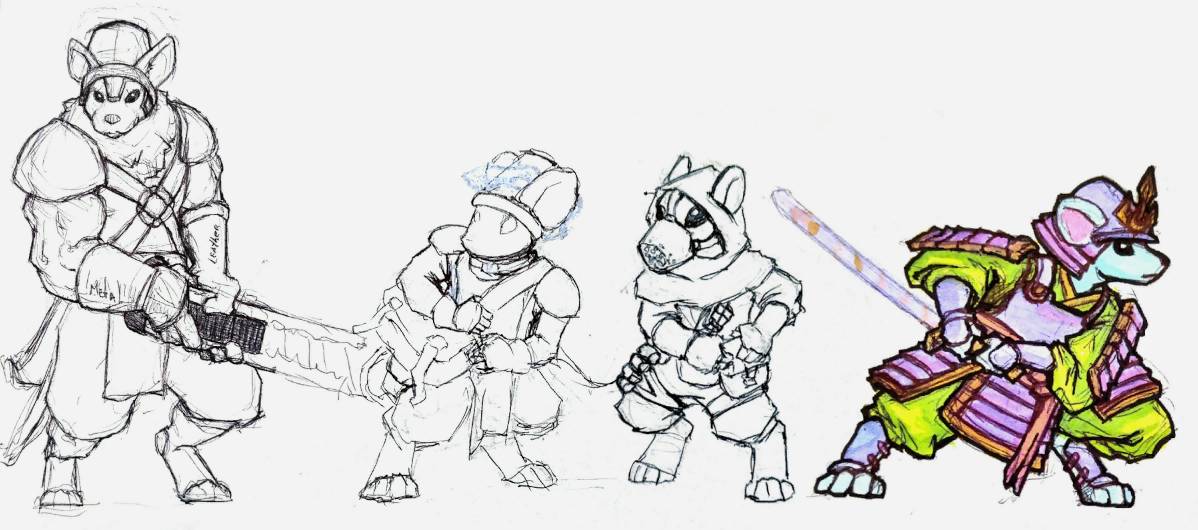
Various concepts drawn by Leo. On the left, you can see the so-called “muscle mouse”, who can be found in the Rogue League in Vinium.
Kevin: Who came up with the idea of muscle mouse?
Darya: Oh, that wasn’t me.
Kevin: Sometimes we’ll just do things independently, and then think “oh, we probably should have shown this sooner” in-case you would be like, “I hate muscle mouse”.
Darya: People like it when you get a bit weird. When you arrive in Murida, you find a lewd book in the bookshop, and Siobhan says, “oh, I can’t read that”. But by the time you get up to Sky Garden, another year or so into development, you find another lewd magazine, and I just thought, “I’ll draw some mouse erotica”. People really liked that. If you get a bit weird, if you include a muscle mouse, people really like it.
Leo: I tried.
13. THE FUTURE
Kevin: At first, I thought it was downright foolish that you weren’t working on Small Saga 2 already. But now I’ve been working on it for a mere two years, I get it. Still, I think you could do it.
Darya: The annoying thing is, I know exactly what it would be. I’ve got it all planned out in my head. I know who the protagonist is, how the story all plays out...
Kevin: But then you have to make it.
Darya: That’s the thing.
Kevin: Maybe it wouldn’t take another six years. You’ve got the engine, assuming it looks the same.
Darya: It goes back to that thing on compromise. If I had no restrictions at all, it would not look or play the same. Maybe it would play like Resonance of Fate or something.
Kevin: Oh my god.
Darya: But because of the way it works, I would change what I can, keep some things the same, and it would end up being an interesting hybrid.
Kevin: I mean, I could tell you what I would do. The overworld stays mostly the same, but I would change the battle system. I’d be tempted to make the battle system some kind of 3D thing.
Darya: With 3D models?
Kevin: Right.
Darya: But then you have to use 3D models for the overworld too, for consistency. I know what you want. You want to use PS1-styled prerendered backgrounds on the overworld.
Kevin: God, can you imagine? Leo and I were theorising on a slightly more strategy-focused RPG like Valkyria Chronicles, semi-turn-based. But how long will it take? Prototypes are fast, but...
Darya: What we need to do is make one of those three month games.
Kevin: The dream is the three month game, but it’s impossible. We’ve never come close to it. If you have an idea for Small Saga 1.5 that you can make in three months, do it.
Leo: Put one of those Kingdom Hearts titles on it.
Kevin: Give the people what they want. They have to play the Lance prequel.
Darya: Small Saga fighting game. Small Saga kart racing.
Leo: Call it Chariot Chuesday.
Kevin: Every time I make a game now, I’m going to be like, “can I put Verm in here?” and you’re going to be like, “please, Kevin, leave me alone”. But what are your thoughts on a sequel?
Darya: I’ve been toying with the idea. I’ve been working on prototypes for other games as well though, and creatively I think it would be more interesting to do something completely different.
Kevin: For sure. I can understand wanting to distance yourself from it.
Darya: I haven’t soured on the Small Saga world. I haven’t drawn a line under it. There’s more to it.
Kevin: You’re saying it’s not off the table, but it’s also not on the table. You can put that in writing.
Darya: Well, look. What’s missing from Small Saga is the badger. There are no badgers in Small Saga, and that’s a huge misstep. They’re an iconic British creature. I need to put badgers in something.
Kevin: One of the most fun things is thinking about what a potential Small Saga 2 would involve and what animals would it involve. Did you have a badger character ever?
Darya: Yes, there was a badger blacksmith who got cut early. Going back a sec, the owls in Sky Garden were originally going to be parakeets, but there were two problems with that. The first is that people don’t realise that we have parakeets in London. The second is that they don’t work thematically for a spooky area.
Kevin: Sure. It would have changed the tone a bit. The owls were a good choice.
Darya: The point is, there are plenty of animals for a potential Small Saga 2. There is no shortage of British wildlife. Go watch some David Attenborough.
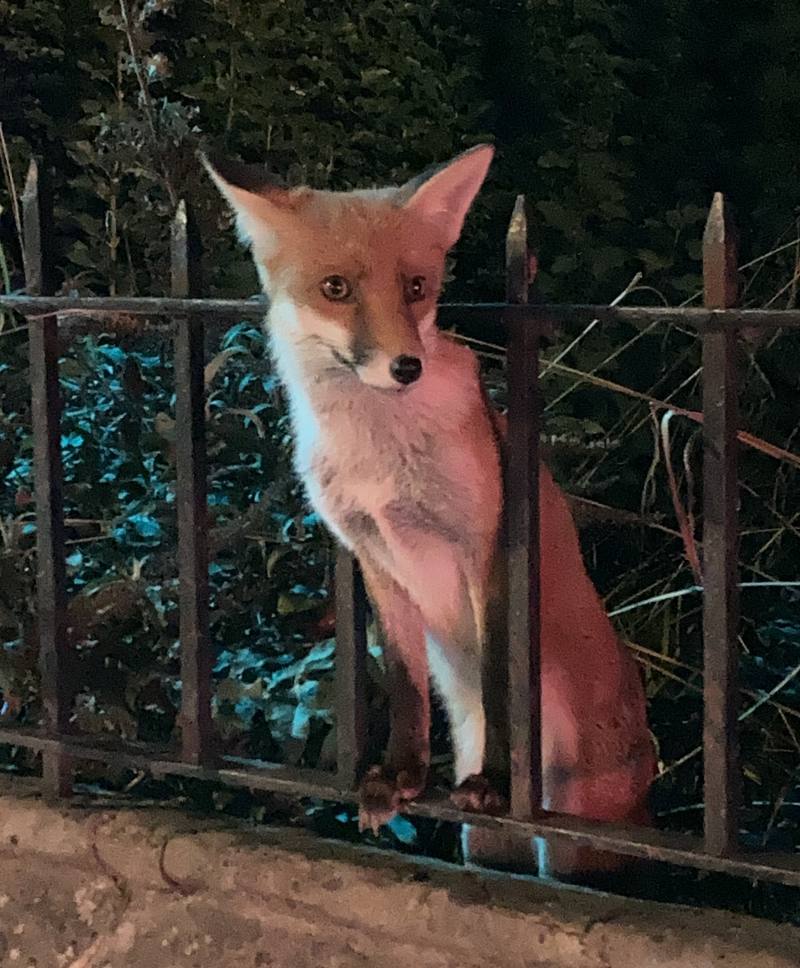
A photo of a London fox, taken by Darya in Belsize Park.